

Analytical (Asymptotic) Performance Analysis
Chapter 18
Learning Outcomes
After completing this lecture and the related lab, students will be able to:
Define and distinguish between empirical and analytical methods of evaluating algorithm performance, and articulate when each method is more appropriate.
Identify key operations to count in an algorithm (e.g., comparisons, swaps, recursive calls, etc.), and use these to characterize the time complexity of simple code segments.
Explain best-case, average-case, and worst-case behavior for algorithms, including what those mean and why we often focus on worst-case or average-case analysis.
Apply rules of estimation to compute cost functions for loops (including nested loops), conditionals, and simple recursive functions.
Understand and use Big-O notation: identify the dominating term in a cost expression, compare growth rates, and classify functions by their asymptotic behavior (constant, logarithmic, linear, quadratic, etc.).
Lecture Video
Why Analyze Algorithms?
The Algorithm-Choice Problem
Dilemma: You have two (or more) methods to solve a problem.
How do you choose the BEST method?
One approach: Implement each algorithm in C++; test how long each takes to run.
Problems:
Different implementations may cause an algorithm to run faster/slower.
Some algorithms run faster on some computers.
Algorithms may perform differently depending on data (e.g., sorting often depends on what is being sorted).
The Cost of an Algorithm
One of the most fundamental tools for computer scientists to analyze the cost of an algorithm.
The cost can be described in terms of time, space (memory usage), electricity, etc.
Ideally, we will develop a simple scheme to rank algorithms from best to worst.
Empirical and Analytical Analysis
Comment on the “general” performance of the algorithm using one of two options:
Empirical (Experimental): Measure performance for several examples.
But, what does this tell us in general?Analytical (Asymptotic):
Instead, assess performance in an abstract, generalized manner.
Idea: analyze performance as the size of problem growth.
Examples:
Sorting: How many comparisons for an array of size
? Searching: How many comparisons for an array of size
?
Challenge: It may be difficult to discover a reasonable formula.
Counting Key Operations
Characterize performance by counting the number of of key operations.
For a sorting algorithm, the key operations includes
the number of times:two values are compared and
two values are swapped.
Search:
- Count the number of times the value being searched for is compared to values in an array.
Recursive function:
- Count the number of recursive calls.
Best-Case, Average-Case, and Worst-Case
Example: some sorting algorithms may require as few as
comparisons and as many as . Types of analyses based a problem of size
: Best case: What is the shortest an algorithm can run?
Average case: On average, how fast does an algorithm run?
Worst case: What is the longest an algorithm can run?
Computer scientists usually use worst-case or average-case analysis.
- What are some example domains where you may care more about the worst case than the average case and vice versa?
Why We Approximating
Usually, we approximate or estimate the performance of an algorithm, assuming it is operating on a very large data set.
Estimation is an important skill to learn and use.
A Simple Approximation Example
The ESB is
feet tall. Assuming that a hotdog is 6 inches from end to end, you would need,
hotdogs.

Estimating Algorithm Costs (Complexity Analysis)
What Complexity Analysis Measures
An objective way to evaluate the cost of an algorithm or code section.
The cost is usually computed in terms of time or space.
The goal is to have a meaningful way to compare algorithms based on a common measure.
Rules for Counting Operations
Algorithm analysis requires a set of rules to determine how operations are to be counted.
There is no generally accepted set of rules for algorithm analysis.
In some cases, an exact count of operations is desired; in other cases, a general approximation is sufficient.
The following rules are typical of those intended to exactly count operations.
Basic Operation Costs
We assume an arbitrary time unit.
Execution of one of the following operations takes time 1:
assignment operation
single I/O operations
single Boolean operations, numeric comparisons
single arithmetic operations
function return
array index operations, pointer dereferences
Example: Counting Assignment and Arithmetic Costs
count = count + 1;  // Cost: c₁
sum = sum + count; // Cost: c₂Total Cost =
Because we assume the addition costs 1 and assignment costs 1, the total cost is 4 units.
Example: Conditional Statements
if (n < 0) {     // Cost: c₁ = 1$
    absVal = -n; // Cost: c₂ = 2$
} else {
    absVal = n;  // Cost: c₃ = 1$
}is the cost of the boolean evaluation ( instruction). is the cost of the negating a number ( ) + the cost of assignment ( ). is the cost of an assignment ( ). Worse Case Best Cast Average
Example: A Linear Loop
i = 1;             // Cost: c₁ = 1
sum = 0;           // Cost: c₂ = 1
while (i <= n) {   // Cost: c₃ = 1
    i = i + 1;     // Cost: c₄ = 1 + 1 = 2
    sum = sum + i; // Cost: c₅ = 2
}Remember assignment (
=) and addition (+) each cost. How many times does the loop execute?
times.
Rules for Conditionals, Loops, and Function Calls
Selection statement (if, switch) time is the time for the condition evaluation, plus the maximum of the running times for the individual clauses in the selection.
Loop execution time is the number or iterations multiplied by its body’s execution time, plus the time for the loop check and update operations, plus the loop setup time.
Always assume that the loop iterates the maximum number of times.The runtime of a function call is 1 for setup plus the time for any parameter calculations plus the time required for the execution of the function body.
Example: Nested Loops
i = 1;                 // c₁ = 1
sum = 0;               // c₂ = 1
while (i <= n) {       // c₃ = 1
    j = 1;             // c₄ = 1
    while (j <= n) {   // c₅ = 1
        sum += i;      // c₆ = 2
        ++j;           // c₇ = 2
    }
    ++i;               // c₈ = 2
}The outer loop iterates
times. For each iteration of the outer loop, the inner loop iterates
times. The total cost is:
Important Note:
Big-O Growth Rates
Comparing Cost Functions
An algorithm’s time requirement is a function of the problem size.
The problem size depends on the application (e.g., the number of list elements for a sorting algorithm).
For instance, we say that (if the problem size is
) Algorithm A requires
time units to solve a problem of size . Algorithm B requires
time units to solve a problem of size .
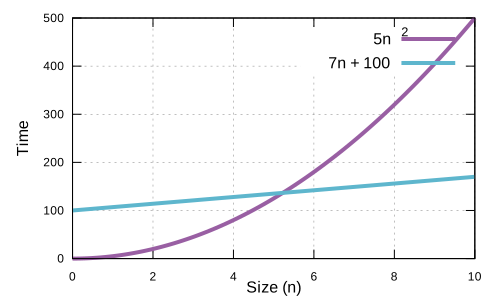
Comparing Algorithm A ( ) with Algorithm B ( ) 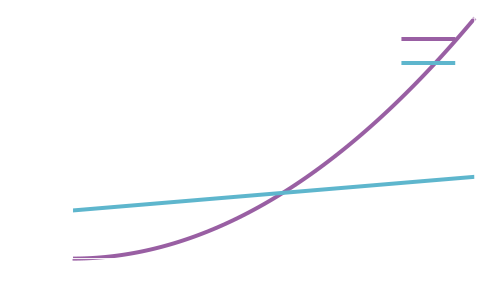
Comparing Algorithm A ( ) with Algorithm B ( )
Growth Rate
An algorithm’s proportional time requirement is known as the growth rate.
We can compare the efficiency of algorithms by comparing their growth rates.
Why the Input Size Matters
Example: Which Cost Function Grows Faster?
It depends on
| 1 | 120 | 37 |
| 2 | 511 | 71 |
| 3 | 1,374 | 159 |
| 4 | 2,895 | 397 |
| 5 | 5,260 | 1,073 |
| 6 | 8,655 | 3,051 |
| 7 | 13,266 | 8,923 |
| 8 | 19,279 | 26,465 |
| 9 | 26,880 | 79,005 |
| 10 | 36,255 | 236,527 |
Identifying the Dominant Term
We only care about the highest-order (dominating) term.
| 1 | 37 | 32.4% |
| 2 | 71 | 50.7% |
| 3 | 159 | 67.9% |
| 4 | 397 | 81.6% |
| 5 | 1,073 | 90.6% |
| ⋮ | ⋮ | ⋮ |
| 9 | 79,005 | 99.7% |
| 10 | 236,527 | 99.9% |
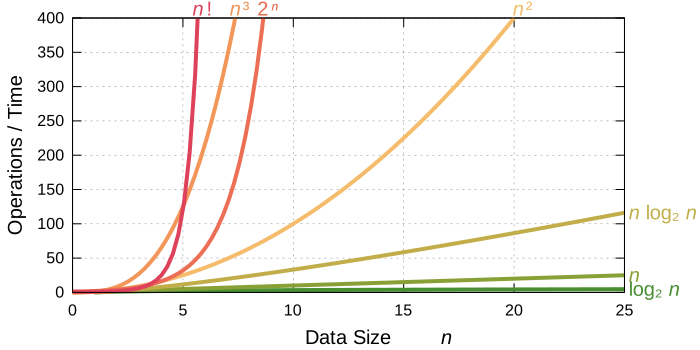
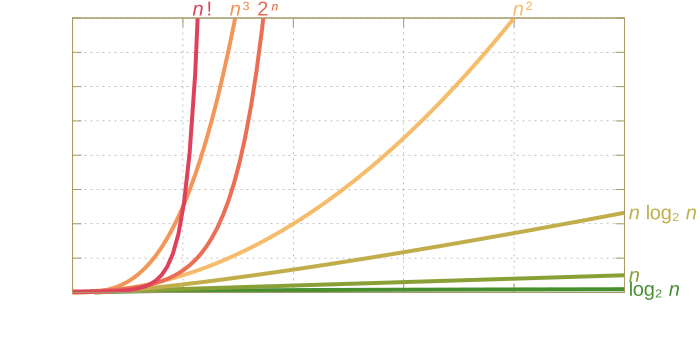
Common Growth Rates
| n=10 | n=100 | n=1,000 | n=10,000 | n=100,000 | |
|---|---|---|---|---|---|
| ... |
Defining Big-O Notation
If Algorithm A requires time proportional to
,
Algorithm A is said to be order, and it is denoted as . The function
is called the algorithm’s growth-rate function. Since the capital
is used in the notation, this notation is called the Big- notation. If Algorithm A requires time proportional to
, it is . If Algorithm A requires time proportional to
, it is .
Example: Classifying a Quadratic Function
If an algorithm requires
seconds to solve a problem size, . If constants
and exist such that for all and ,
then the algorithm is order. (In fact, is 3 and is 2) Thus, the algorithm requires no more than
time units. So it is
Practice: Finding the Dominant Term
This game of “spot the highest term” is actually not difficult!
= =
It can get somewhat tricky:
= =
Growth-Rate Classes at a Glance
| Big O | Time requirement as problem size increase |
|---|---|
| Constant is independent of the problem’s size. | |
| Logarithmic increases increases slowly. | |
| Linear increases directly. | |
| Increases more rapidly than linear algorithms. | |
| Quadratic increases rapidly. | |
| Cubic increases more rapidly than a quadratic algorithm. | |
| Exponential is impractical. |
Worked Complexity Examples
Linear Time:
i = 1;           // Cost: c₁
sum = 0;         // Cost: c₂
while (i <= n) { // Cost: c₃
    ++i;         // Cost: c₄
    sum += i;    // Cost: c₅
}Quadratic Time:
i = 1;               // Cost: c₁
sum = 0;             // Cost: c₂
while (i <= n) {     // Cost: c₃
    j = 1;           // Cost: c₄
    while (j <= n) { // Cost: c₅
        sum += i;    // Cost: c₆
        ++j;         // Cost: c₇
    }
    ++i;             // Cost: c₈
}Cubic Time:
for (i = 1; i <= n; i++) {         // Cost: c₁
    for (j = 1; j <= i; j++) {     // Cost: c₂
        for (k = 1; k <= j; k++) { // Cost: c₃
            ++x;                   // Cost: c₄ = 2$
        }
    }
}Notice: We do NOT need to know the exact number of iterations to find the Big-
Exponential Time: Recursion and the Tower of Hanoi
The Tower of Hanoi is a puzzle consisting of three rods some disks of different diameters, which can slide onto any rod. The goal is to move the disc to a different rode. However, a larger disk cannot be placed on top of a smaller one.
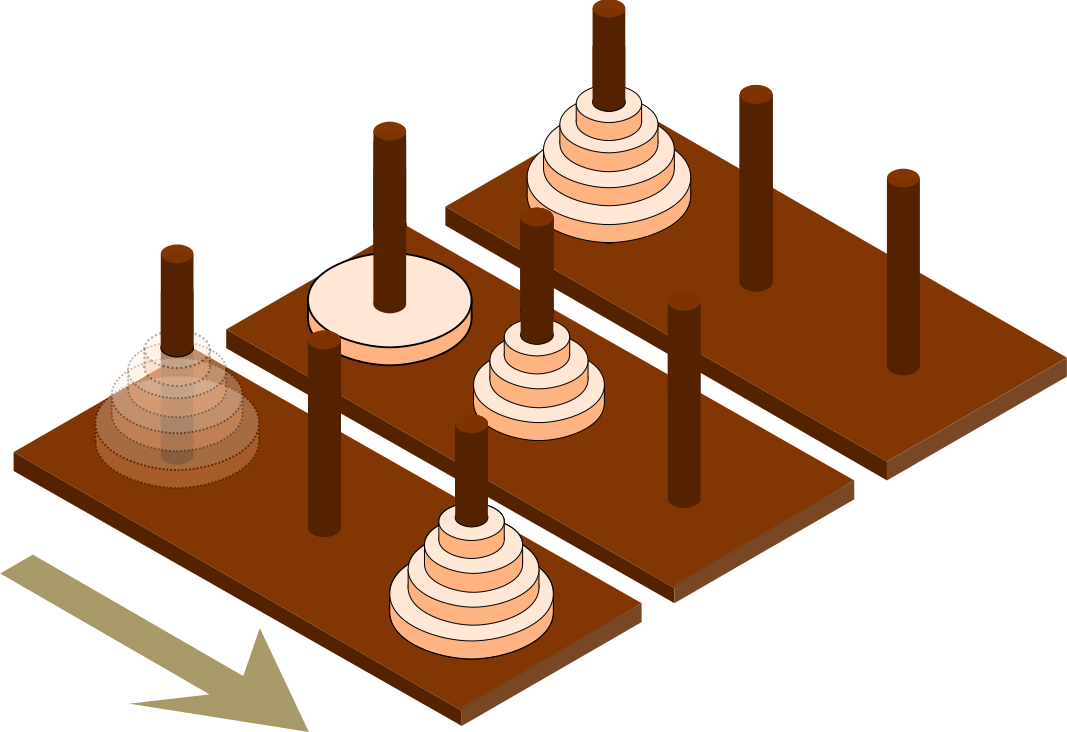
void hanoi(int n, char source, char dest, char spare) { // Function-call cost
  if (n > 0) {                                     // Cost: c₁
    hanoi(n-1, source, spare, dest);               // Cost: c₂
    cout << "Move top disk from pole " << source
      << " to pole " << dest << endl;              // Cost: c₃
    hanoi(n-1, spare, dest, source);               // Cost: c₄
  }
}By now, I hope you see that constant and coefficient costs are virtually superfluous when working with Big
. To find the growth-rate function for a recursive algorithm, we have to solve its recurrence relation.
You will learn how to do this in Discrete Math.
Analyzing the Tower of Hanoi Recurrence
When
, When
,
=
=recurrence equation for the growth-rate function of hanoi-towers algorithm. Now, we have to solve this recurrence equation to find the growth-rate function of the hanoi-towers algorithm.
This turns out to be
because for every we make calls.
Linear Time: Constant-Factor Work,
int bigOExample5(const int N)
{
  const int M = 4 * N;
  int res = 0;

  int *pArray = new int[M] {};
  for(int i = 0; i < M; i++)
  {
    m_pArray[i] = i;
  }
  for(int i = 0; i < M; i++)
  {
    res += m_pArray[i];
  }
  delete[] pArray;
  return res;
}Linear Time: Nested Constant Work,
int bigOExample6(int n)
{
  int total = 0;

  for(int i = 0; i < 4 * n; i++)
  {
    total += i;

    for(int j = 0; j < 4; j++)
    {
      total += j;
    }
  }

  return total;
}Log-Linear Time:
int bigOExample7(int n) {
  int total = 0;
  for(int i = 0; i < n; i++) {
    for(int j = 1; j <= n; j *= 2) {
      total += j;
    }
  }

  return total;
}