

Binary Heaps and Heapsort
Chapter 10 of Open Data Structures
Intro
Why study Heapsort?
Heapsort is a well-known, traditional sorting
algorithm you are expected to know.Heapsort is always
. Learn about binary search trees to:
Quicksort is usually
but in the worst case. Quicksort is sometimes faster, but Heapsort is better in time-critical applications.
Merge Sort is also
, but requires additional memory to sort an array.
Can improve our Priority Queue design (in certain situations).
What is a “heap”?
There are two definitions of heap.
Memory: A large area of memory from which the programmer can allocate blocks as needed, and deallocate them (or allow them to be garbage collected) when no longer needed.
Data Structure: A balanced, left-justified binary tree in which no node has a value greater than its parent (binary heap).
These two definitions have little in common.
Heapsort uses the second definition.
Two Properties of a Binary Heap
The heap data structure is a binary tree that maintains two properties, which we will discuss.
Shape Property: Left Justified and, therefore, Balanced
Heap Property: The relationship between elements
Balanced Binary Trees
Recall:
The depth of a node is its distance from the root.
The depth of a tree is the depth of the deepest node.
A binary tree of depth
is balanced if all the nodes at depths 0 through have two children.
Left-Justified Binary Trees
A binary tree is left-justified if:
Balanced (All levels, except possibly at depth
(deepest), are filled.) All leaves at depth
are to the left (without any missing).
(All leaves at depthare to the right of all the nodes at depth .)
The Heap Property
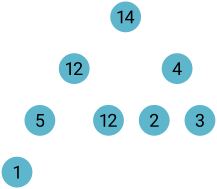
A node has the heap property if the value in the node
is at least as large as its children’s values.All leaves automatically have the heap property.
A binary tree is a heap if all nodes in it have the heap property.

Shift Up
If a node is without the heap property, exchange
its value with the larger child’s value.
This is sometimes called sifting up or bubble up.
Notice that the child may have lost the heap property during shifting.
Plan of Attack
We will discover:
How to turn a binary tree into a heap.
After particular changes, how to turn a binary tree back into a heap.
How to use these ideas to sort an array.
(This is the cool part.)
Inserting into a Heap
A single-node tree is automatically a heap.
We construct a heap by adding nodes one at a time:
Add the node just to the right of the rightmost node in the deepest level.
If the deepest level is full, start a new level.
Example:
Problem: Each time we add a node, we may destroy
the heap property of its parent node.Solution: Sift up (a.k.a., bubble up).
But each time we sift up, the value of the topmost node in the sift may increase, and this may destroy the heap property of its parent node.
We repeat the sifting up process, moving up in the tree, until either:
We reach a node whose value doesn’t need to be swapped (because the parent is larger than both children), or
We reach the root.
Insert 8, 10, 5, 11, 6, 14, and 12.
A Sample Heap
Here is a sample heapified binary tree.
Heapified does not mean sorted.
Heapifying does not change the shape of the binary tree.
This binary tree was always balanced and left-justified.
Remove
Removing the Root
The largest number is now in the root.
Suppose we discard the root.
Problem: The tree becomes unbalanced and un-left-justified.
Solution: Make the rightmost leaf the new root.
Re-Heap by Sifting Down
Our tree is balanced and left-justified, but no longer a heap.
Only the root lacks the heap property.
We sift down (or trickle down) the root.
Now, only one child may have lost the heap property.
Re-Heap (Sift-Down)
Now, the left child of the root (currently 11) lacks the heap property.
We can sift down this node.
Now, only one of its children may have lost the heap property.
Re-Heap (Sift-Down)
Now, the right child of the left child of the root (currently 11) lacks the heap property.
We can sift down this node.
It is a leaf, so there are children to lost the heap property.
Every node again has the heap property.
The largest value is at the root.
Repeating until the tree is empty will produce produces a sequence ordered from largest to smallest.
Sorting
What do heaps have to do with sorting an array?
Because the binary tree is balanced and left-justified, it can be represented as an array!
All our operations on binary trees can be represented as operations on arrays.
Mapping into an Array
The left child of index,
, is at The right child of index,
, is at
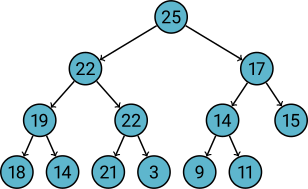
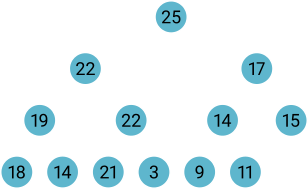


Ex: Children of
( ) are ( ) and ( ). Given a child, what is it’s parent’s index?
Removing and Replacing the Root
The “root” is the first element in the array.
The “deepest rightmost node” is the last element.
Remove the root by swapping the first and last values.
…pretend that the last element in the array no
longer exists — the “last index” is 11 (9).
Reheap and Repeat
Re-heap the root node (index 0, containing 11).
Again, remove and replace the root node.
Remember, though, that the “last” array index is changed.
Repeat until the last becomes first, and the array is sorted!
Implementation
We implemented and tested a binary heap class in the lecture.
Analysis
Step 1, Heapify the Array
The sorting algorithm starts by heapifying the array.
We add each of
nodes. Each node must be sifted up, possibly as far as the root.
Because the binary tree is perfectly balanced, sifting up a single node takestime. Because we iterate
times, heapifying takes time, that is, time.
Step 2, Remove
Here’s the rest of the algorithm:
Algorithm Pseudocode (Part 2)
plainWhile the array isn’t empty: { Remove and replace the root. Reheap the new root node. }We do the while loop
times (actually, times), because we remove one of the nodes each time. Removing and replacing the root takes
time. Therefore, the total time is
times however long it takes the reheap method.
Step 3, Reheap
To reheap the root node, we must follow one path from the root to a leaf node (and we might stop before we reach a leaf).
The binary tree is perfectly balanced.
Therefore, this path is
long. And we only do
operations at each node. Therefore, a reheap takes
time.
Since we reheap inside a while loop that we do
times, the total time for the while loop is , or .
Performance of All Steps
Heapify the array.
While the array isn’t empty:
{
  Remove and replace the root.
  Reheap the new root node.
}We have seen that heapifying takes
time. The while loop takes
time. Therefore, the total time is
. Which is
time (average- and worst-case).
Summary of Benefits
Efficient Operations: Insertion and deletion are
. Retrieval of the minimum (or maximum) element is . Space Efficiency: Binary heaps can be implemented using arrays, removing the need for pointers.
Ease of Implementation: With arrays, the algorithms for insertion, deletion, and heapifying are intuitive.
Heapsort: An always
in-place sorting algorithm (i.e., additional space and with predictable performance). Priority Queue: Many algorithms require elements with higher (or lower) priority to be processed first.
Visual Comparison of Sorting Algorithms
Introspective Sort (Introsort)
Now that we have a many sorting algorithms, consider that we can combine them to achieve better average performance.
Introsort combines Quicksort, Insertion Sort, and Heapsort,
Approach:
- Start with Quicksort for its fast average-case performance (
). - Track the recursion depth.
- If the depth exceeds a threshold (typically
), switch to Heapsort to avoid quicksort's worst case ( ). - For small subarrays (size 16 to 32), use Insertion Sort for efficiency.
Lab 16: Binary Heap and Heapsort
Let’s take a look at the lab based on today’s lecture.