

Priority Queues
Introduction
A stack is first in, last out.
A queue is first in, first out.
A priority queue is a highest-priority first-out container.
The “highest-priority” element is removed first. Priority is determined from the elements’ values, usually largest to smallest or vice versa.
The definition of “largest” is up to the programmer (for example, you might define it by implementing a Compare function object.)
If there are several “largest” elements, the implementer must decide which to remove first.
Remove any “largest” element (don’t care which).
Remove the first one added.
Popular Priority Queue Uses
Task scheduling in operating systems (highest-priority processes run first).
Dijkstra's algorithm for shortest paths (select the next closest node).
A search* and other graph traversal techniques (best candidate expansion).
Event-driven simulation (next event by earliest time).
Huffman coding and compression (combine nodes by lowest frequency).
A Priority Queue ADT
Here is one possible ADT:
PriorityQueue(): a constructorvoid add(const Type &val): insertsvalinto the queueType& pop(): removes and returns the highest-priority elementconst Type& top() const: returns (but does not remove) the highest-priority elementbool isEmpty() const: returns true IFF emptyunsigned int size() const: returns the element countvoid clear(): discards all elements
Performance
Evaluating Implementations
When choosing a data structure, consider
usage patterns.If data is loaded once and searched thousands of
times, make searching fast by sorting the array.If we load a huge data and expect to do only a few searches, we probably don’t want to spend time sorting.
For almost all uses of a queue (including a priority queue), we eventually remove everything.
Hence, when we analyze a priority queue, neither ‘add’ nor “remove” is more important — we must look at the timing for “add + remove”.
Array Implementations: Unsorted
A priority queue could be implemented as an unsorted
array (with a count of elements).
Adding an element would take
time. (Why?) Removing an element would take
time. (Why?) Hence, adding and removing an element takes
time. This is an inefficient representation.
Array Implementations: Sorted
A priority queue could be implemented as a sorted array (again, with a count of elements).
Adding an element would take
time. (Why?) Removing an element would take
time. (Why?) Hence, adding and removing an element takes
time. Again, this is inefficient.
Linked-List Implementations
A priority queue could be implemented linked list that is…
Unsorted:
Adding an element would take
time (Why?) Removing an element would take
time (Why?)
Sorted:
Adding an element would take
time (Why?) Removing an element would take
time (Why?)
As with array representations, adding and removing an element takes
time. Again, these are inefficient implementations.
Binary Search Tree Implementations
A priority queue could be represented as an
unbalanced binary search tree.Insertion times would range from to
Removal times would range from to
A priority queue could be represented as a balanced binary search tree.
Insertion and removal could destroy the balance.
We need an algorithm to rebalance the binary tree.
Good rebalancing algorithms require only
time but are complicated.
Heap Implementation
A priority queue can be implemented as a heap, which are…
Balanced
Left-Justified, and have
The Heap Property: values are least as large as its children.
(Or smaller if smaller values represent higher priorities.)
Heap: All nodes have the heap property.
Array Representation of a Heap
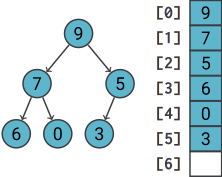
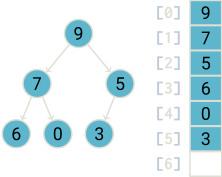
Left child of node
is at ; right child is at .
If the result is larger than the last index, there is no such child.Parent of node
is , unless == .
Adding Element to the Heap
Increase
lastIndexand put the new value there.Reheap the newly added element by sifting up.
(a.k.a., up-heap bubbling or percolating up).
Sifting up requires
time.
Removing Element from the Heap
Remove the element at location 0.
Move the element at location
lastIndexto location 0, and decrementlastIndex.Reheap the new root node (the one now at location 0) by sifting down.
(a.k.a., down-heap bubbling or percolating down).
Sifting down requires
time.
Using the C++ STL Heap
This is surprising not that bad.
A heap is a vector that has been “heapified.”
- Use the
make_heap()function to “heapifiy” a vector.
- Use the
Further pushes/pops should be done via heap functions.
push_back+push_heap/pop_heap.
Some example code will help.
C++ STL Heap: Create
std::vector<int> v1 {20, 30, 40, 25, 15}; // Initial a vector
std::make_heap(v1.begin(), v1.end());     // Convert into a heap

std::cout << "The max value is " << v1.front() << '\n';C++ STL Heap: Push
v1.push_back(50); // Add a new element to the vector
std::push_heap(v1.begin(), v1.end()); // reorder the elements

std::cout << "The maximum after push is " << v1.front() << '\n';C++ STL Heap: Pop
std::pop_heap(v1.begin(), v1.end());  // remove the maximum

// Displaying the maximum element of the heap
std::cout << "The maximum after pop is " << v1.front() << '\n';C++ STL Heap Functions in <algorithm>
make_heap(): function to “heapifiy” a vector.push_back()+push_heap(): push to the heap.pop_heap(): function to remove the first element and reheap.front(): get the top element (first in the heap/queue).sort_heap(): perform heapsort (the vector is no longer a heap afterward).is_heap(): quick test to see if you are still a heap.is_heap_until(): returns an iterator of what part of the vector is a heap.
Considerations
A priority queue is a data structure that is designed to return elements in order of priority.
Efficiency is usually measured as the sum of the time it takes to add and remove elements.
Simple implementations take
time. A heap implementation takes
time. Thus, for any sort of heavy-duty use, a heap implementation is better.
My Recommendation
If you need a priority queue, define it as an ADT.
Start with a simple implementation.
Keep the implementation hidden so you can change it later.
If appropriate, consider the
std::priority_queueclass, which is part of the C++ STL.
Lab 20: Priority Queues
Let’s look at the lab based on today’s lecture.