

Graphs via Adjacency Lists
Chapter 20
Review
Graph Data Structures
To process and manipulate graphs, we must store
graphs in computer memory.
A graph is commonly represented in one of two ways:
Adjacency matrices
Adjacency lists
Adjacency Matrix: Weighted Directed Example
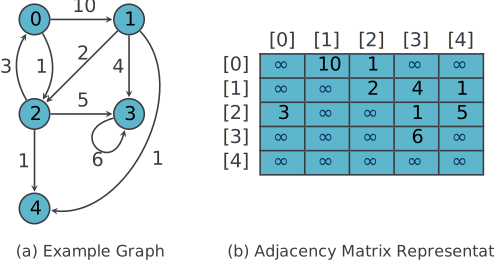
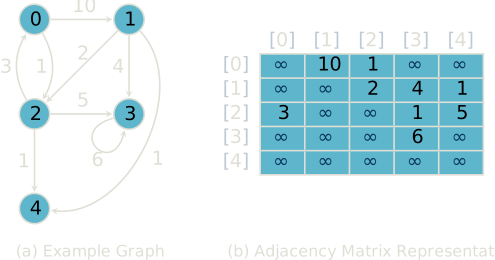
If the edges have weights, they are stored in the matrix.
Limitations of Adjacency Matrices
Wasted space,
. It stores a weight for an edge
from every vertex to every other vertex.
Most graphs are sparse.Slow iteration over edges.
Slow add/delete of vertices.
Cannot represent parallel edges.
Adjacency Lists
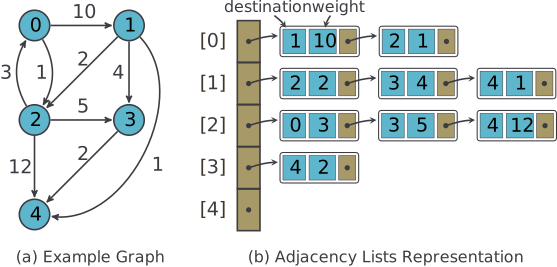
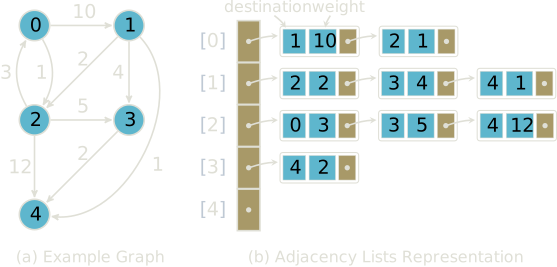
Implemented using a vector of lists (e.g., std::vector<std::list<Edge>>). Each node in a list represents an edge, storing the destination vertex and edge weight. This representation uses
Minimal Spanning Trees
A Spanning Tree is a subset of the edges in the graph that connects all vertices without creating any cycles.
A Minimum Spanning Tree is a spanning tree that minimizes the total edge cost.
A graph has a spanning tree if and only if it is connected.
Spanning Tree: Examples
Suppose an airline’s connections are represented by the following graph. The edge weights are the costs. How can the airline minimize costs while still being able to fly to every city?
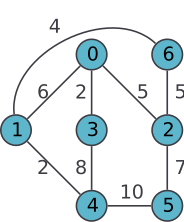
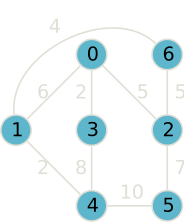
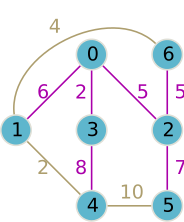
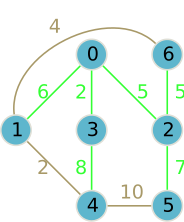
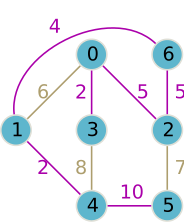

The minimal spanning tree for the above graph is
Minimal Spanning Tree Algorithms
Well-known algorithms to find a minimal spanning tree
of an undirected and connected graph.
Kruskal’s algorithm (published 1956)
Prim’s algorithm (rediscovered in 1957)
Builds the tree iteratively by adding edges until a minimal spanning tree is obtained.
Start with a designated vertex, called the source vertex.
At each iteration, a new edge that does not complete a cycle is added to the tree.
Prim’s Minimal Spanning Tree Algorithm
Prim’s Algorithm: Pseudo Code
Local Variables in prims():
vertexCount: the number of vertices in the graph. A spanning tree has exactlyvertexCount - 1edges.Priority Queue of Edges (initially empty). The Edge type contains from and to vertices and the weight.
wasVisited``[Node Count]: set to allfalse.totalCost = 0edgeCount = 0List of Edges in MST (initially empty).
Function: prims(startIdx):
  enqueueEdges (startIdx, wasVisited, edgeQueue);
  while (!edgeQueue.empty() && edgeCount < vertexCount - 1)
    edge = edgeQueue.dequeue()
    if (!wasVisited[edge.destination])
      mstEdges.enqueue(edge)
      ++edgeCount
    totalCost += edge.weight
    enqueueEdges (edge.destination, wasVisited, edgeQueue)
return (edgeCount != vertexCount - 1) ? -1 : totalCostFunction enqueueEdges (fromVertex, wasVisited[], edgeQueue):
// Mark the current node as visited.
wasVisited[fromVertex] = true;
// Iterate over the edges of the current vertex.
// Add edges to unvisited nodes the queue
for (const auto &edge : mAdjacencyLists[fromVertex])
if (!wasVisited[edge.destination])
edgeQueue.enqueue({fromVertex, edge.destination, edge.weight});Performance
Adjacency Matrix: Faster for checking if an edge exists between two specific vertices (O(1) lookup). Best for dense graphs where most vertices are connected.
Adjacency List: Faster for iterating over edges (O(V+E)), requires less space for sparse graphs (O(V+E) vs O(V²)), and supports parallel edges. Prim's algorithm runs in O((V + E) log E) time with adjacency lists.
Memory Efficiency: Adjacency lists are far more efficient for sparse graphs (few edges relative to vertices). Adjacency matrices always use O(V²) space regardless of edge count.
Summary
A graph
is a pair, . In an undirected graph
,
the elements ofare unordered pairs. In a directed graph
,
the elements ofare ordered pairs. is a subgraph of if every vertex of is a vertex of and every edge is an edge in . Two vertices in an undirected graph are adjacent if there is an edge between them.
Loop: an edge incident on a single vertex.
Simple graph: no loops and no parallel edges.
Simple path: all the vertices, except possibly the first and last vertices, are distinct.
Cycle: a simple path in which the first and last vertices are the same.
An undirected graph is connected if there is a path from any vertex to any other vertex.
The shortest path algorithm gives the shortest distance for a given node to every other node in the graph.
In a weighted graph, every edge has a nonnegative weight.
A rooted tree is a tree in which a particular vertex is designated as a root.
A tree
is called a spanning tree of graph if is a subgraph of G such that .
Lab 23: Graphs via Adjacency Lists
Let’s look at the lab based on today’s lecture.