

Quadtrees (with Smart Pointers)
Motivation
Suppose we have a set of 2D points and we want to be able to query how many points lie in a particular rectangle.
A brute force approach would be
We want a way to more efficiently count points contained within a rectangular region.
Explanation
Each node in a Quadtree has a bounding rectangle. If the node is not a leaf then it has 4 children, splitting the rectangle into four quadrants.
Points are also attached to nodes. We define a constant specifying the maximum number of points associated with each node.
Insertion
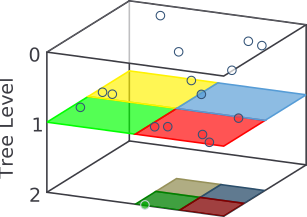

Query
Use recursion to count the number of points in a
given range.Consider only nodes that overlap with the query range.
Time Complexity
If the points are distributed uniformly in the root’s
range, then insertions and queries are logarithmic.
However, if they are not uniformly distributed
then it can degrade to linear time.
Quadrant Contains a Point
Region Intersects a Quad
Modern C++ Memory Management
In modern C++, smart pointers are preferred for dynamic memory management, instead of raw new and delete.
std::unique_ptris a smart pointer that owns and manages a dynamically allocated object.It automatically deletes the object when it goes out of scope, preventing memory leaks.
Ownership is exclusive: cannot be copied, only moved.
std::unique_ptr Example
#include <memory>
void example() {
  std::unique_ptr<int> p = std::make_unique<int>();
  *p = 42;
  // When example() returns, p is destroyed,
  // and the int is automatically deleted.
}The object is freed automatically when the smart pointer goes out of scope.
No explicit
deleteis required.
Example Implementation
This is how you might implement std::unique_ptr if you needed to. Seeing an example implementation shows how simple it is (just a wrapper for a pointer).
// Incomplete Example (doesn't handle move semantics)
template<typename Type>
class UniquePointer {
public:
  UniquePointer(Type* datum = nullptr) : mDatum{datum}
  {}

  ~UniquePointer() { delete mDatum; }

  // Remove default copy semantics.
  UniquePointer(const UniquePointer &)            = delete;
  UniquePointer& operator=(const UniquePointer &) = delete;

  // Accessors for owned object
  Type* operator->() const {return mDatum;}
  Type& operator*()  const {return *mDatum;}
private:
  Type* mDatum;
};std::make_unique vs new Preferred form:
auto p = std::make_unique<Quadtree>();
Works well with type deduction (
auto) and is exception-safe.Allocation and ownership transfer happen in one step.
Allowed, but less preferred:std::unique_ptr<Quadtree> p{new Quadtree()};
- More verbose and unsafe if an exception is thrown between
newand the constructor ofstd::unique_ptr.
Advantages and Disadvantages Advantages:
Automatic resource management.
Resource Acquisition is Initialization (RAII).Prevents memory leaks and dangling pointers.
Exception-safe.
Cleaner, more readable code.
Disadvantages:
Ownership semantics restrict copying.
Slight performance overhead.
Learning curve for ownership rules.
Other Smart Pointers
std::shared_ptr— shared ownershipstd::weak_ptr— non-owning reference to object managed bystd::shared_ptr
Rule of 0
Rule of 3: If you define any of destructor, copy constructor, or copy assignment operator, define all three.
Rule of 0: If you don't need to define any special member functions, don't define any.
Rely on compiler-generated defaults or use smart pointers for resource management.
Quadtree Subtree Implementation The 4 subtrees are defined using:
// Replaces:
// Quadtree* mQuads = new Quadtree[4];
std::array<std::unique_ptr<Quadtree>, 4> mQuads;std::arrayprovides a fixed-size array with compile-time size.Each subtree is a
std::unique_ptrto aQuadtreenode.Memory is automatically managed; no manual
deleteneeded.
Types of Quadtrees
Region quadtree – Divides region into sub-quadrants based on the areas with more detailed information.
Image processing – only subdivide if pixels differ in color.
Variable resolution data field – each parent has the average value of its children.
Point quadtree – Divide the region at the point that is inserted (like a binary tree but with 4 pointers).
-d trees are preferred. Point-region (PR) quadtree – What we implemented.
Edge quadtree – Stores lines/curves with approximation.
Polygonal map (PM) quadtree – stores polygons.
Compressed quadtrees – only storing subtrees whose leaves have interesting data and removing empty intermediate nodes.
Conclusion
Quadtrees are used to efficiently query the number of points contained within various rectangular ranges.
Quadtrees are most efficient when the points are uniformly distributed.
Lab 24: Quadtrees
Let’s take a look at the lab based on today’s lecture.